
Views: 0 Author: Site Editor Publish Time: 2026-08-07 Origin: Site


When you manage a large commercial or residential build, closet hardware often feels like a minor detail. Yet, procuring the wrong components at scale brings hidden nightmares. Installation delays compound quickly across hundreds of housing units. Weak rods collapse under heavy loads. Inconsistent metallic finishes ruin the aesthetic of a premium project. You cannot afford these disruptions.
A successful bulk purchase hinges on several non-negotiable factors. You need dimensional consistency across every unit. You must demand verified load capacity. Predictable lead times keep your project on schedule. Finally, labor-efficient installation protects your budget. Securing a reliable wardrobe end bracket requires strict supplier vetting.
This article provides a clear, evidence-based evaluation framework. You will learn how to specify and vet closet hardware properly. We guide you through material choices, design tiers, and tolerance requirements. You can use this knowledge to validate suppliers before you issue a large purchase order.
Hardware failure represents the core risk in any bulk closet installation. Mismatched material strength leads to collapsed rods and damaged drywall. You must align the hardware specs with actual wardrobe load expectations. A residential closet holding lightweight summer shirts requires different support than a commercial coatroom handling wet winter jackets. Heavy garments exert immense downward pressure. You must account for this shear stress during the specification phase.
Buyers typically choose between stainless steel and zinc alloy castings. Each material behaves differently under tension. Zinc alloy offers a cost-effective solution for lighter loads. Manufacturers cast it easily into complex shapes. However, cheap zinc alloys pose structural risks. They remain susceptible to snapping under excessive shear stress. Poorly cast zinc brackets fail suddenly. They do not bend; they shatter.
Conversely, a stainless steel end bracket provides exceptional high tensile strength. This metal resists bending and shearing. It maintains long-term structural integrity even under dynamic loads. Stainless steel also offers superior corrosion resistance. You should specify it for humid environments, coastal properties, or premium luxury builds. Rust ruins clothing. Stainless steel eliminates this risk entirely.
You need a strict evaluation lens when assessing load capacity. Never rely on vague marketing claims like "heavy-duty." Request documented weight-bearing thresholds per pair from your manufacturer. Base this requirement on a standard 36-inch to 48-inch rod span. Ask the vendor for laboratory testing reports. Verify how the brackets perform under sustained static loads. Practical experience shows you should build a 20% safety margin into your specifications. If you expect a 50-pound load, specify brackets rated for at least 60 pounds.
Project tiers dictate hardware selection. Multi-family housing requires different visual standards than a boutique retail display. You must balance the upfront unit cost against the expected aesthetic standard of the end-user. Understanding the exact differences between bracket categories prevents you from overspending or under-specifying.
A standard end bracket serves utilitarian purposes. These units feature exposed mounting screws. They typically utilize a basic U-shape or O-shape flange. The finish remains functional rather than decorative. This bracket excels in high-volume, basic storage environments. We recommend them for budget hotel renovations, student dormitories, and standard multi-family housing. In these scenarios, cost-per-unit drives the primary purchasing decision. You want durable functionality without paying for aesthetic upgrades.
A deluxe end bracket elevates the visual experience. These units feature concealed mounting plates. A decorative cover snaps or screws over the base, hiding all wall anchors. They often include integrated set-screws for rod stabilization. You will find them in premium finishes like matte black, brushed nickel, or satin brass. We specify these for custom cabinetry, luxury residential developments, and high-end boutique retail displays. The end-user expects flawless visual execution. Exposed screw heads look cheap in a luxury walk-in closet.
Follow a simple decision logic here. Weigh the initial material cost against your target demographic. Budget projects demand reliable standard hardware. Luxury projects require deluxe hardware to match high-end wood veneers and lighting. Do not mix tiers. Installing standard brackets in custom mahogany cabinets damages your brand reputation.
Comparison of Bracket Tiers
| Feature | Standard Tier | Deluxe Tier |
|---|---|---|
| Mounting Hardware | Exposed screw heads | Concealed beneath decorative covers |
| Rod Stabilization | Gravity or friction fit | Integrated set-screws |
| Typical Finishes | Chrome plated, basic white, zinc | Matte black, brushed nickel, brass |
| Best Application | Dorms, budget hotels, apartments | Custom closets, luxury retail, premium homes |
| Primary Driver | Low cost-per-unit | Aesthetic perfection and high security |
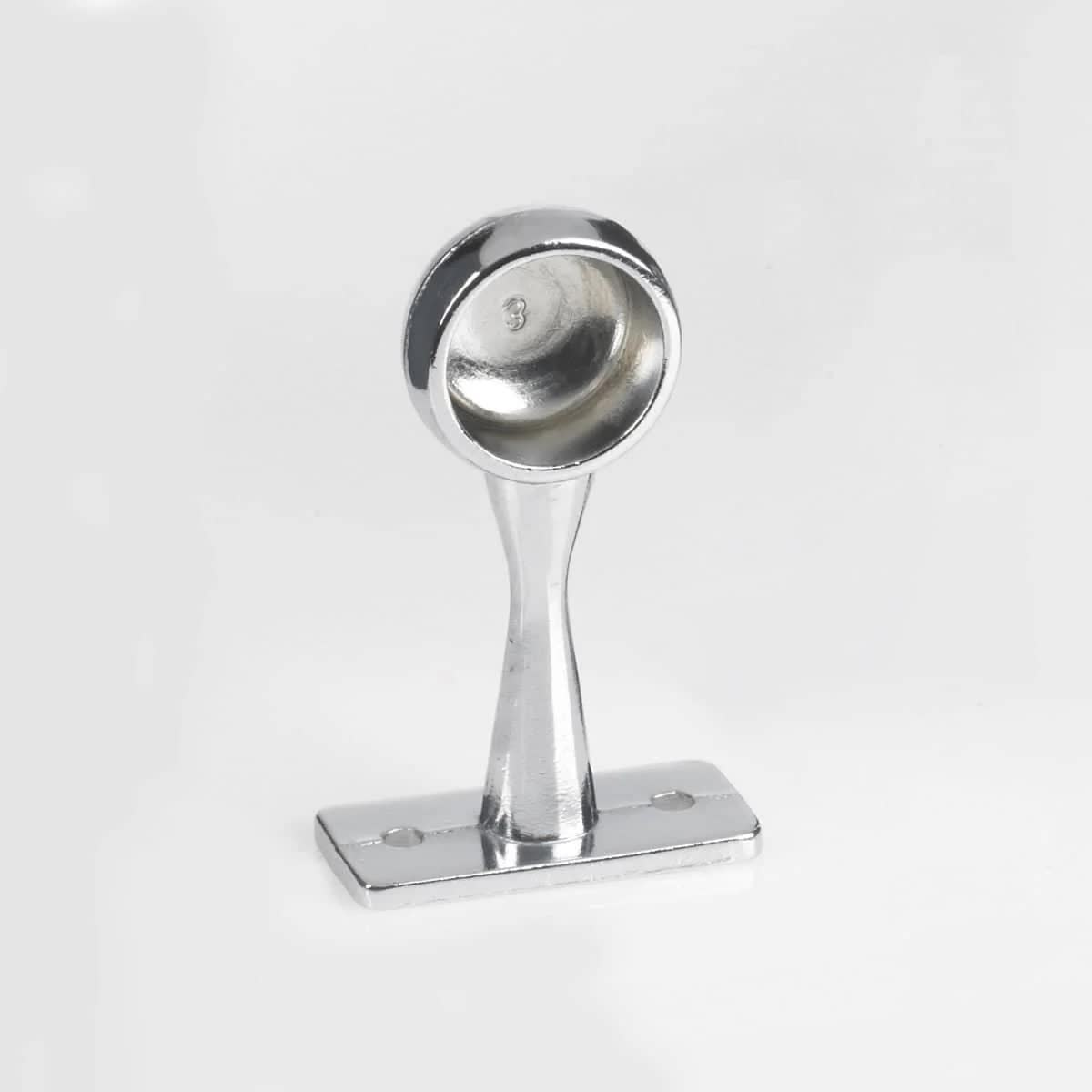
Securing the right material only solves half the problem. Dimensional accuracy matters just as much. You must match the bracket exactingly to the rod profile. Manufacturers produce standard round rods in 15mm, 19mm, and 25mm diameters. Standard oval profiles also exist for wider spans. Mismatching a 19mm rod with a 20mm bracket creates immediate issues.
Microscopic variations in bulk manufacturing cause severe headaches on the job site. Factory molds wear down over time. This wear leads to tolerance drift. If brackets arrive too tight, installers must force the rod into place. This slows down installation considerably. Hammering rods into tight brackets damages the cabinet sidewalls. Installers waste valuable time fighting poorly manufactured parts.
Conversely, brackets manufactured too loose cause noise and instability. A loose rod rattles every time the user slides a hanger across it. This rattling creates a cheap, flimsy acoustic experience. End-users notice this immediately. The rod might even rotate within the bracket. This rotation scratches the metal finish over time. You must demand strict manufacturing tolerances. Request a variance limit of +/- 0.2mm from your supplier.
You should also evaluate security features during the specification phase. High-traffic environments require robust rod retention. Consider brackets featuring integrated set-screws. Once installers place the rod, they tighten a small grub screw against it. This locks the rod firmly in place. It eliminates rattling entirely.
Alternatively, evaluate closed-loop designs. A closed O-shape flange prevents accidental rod dislodgment during heavy use. Hotel guests sometimes pull down roughly on hangers. An open U-shape bracket allows the rod to pop out under upward force. A closed loop captures the rod entirely. This provides ultimate security for commercial environments.
Labor costs frequently exceed material costs on large construction projects. You must evaluate how your hardware choices impact installation speed. A slightly cheaper bracket costs you more if it takes longer to install. You need to calculate these labor cost implications before issuing a bulk order.
Consider a bulk project outfitting 500 hotel rooms. Each room requires two end brackets. That equals 1,000 brackets. If a poorly designed bracket takes just two minutes longer to install, you lose 2,000 minutes. That equals over 33 hours of wasted labor. At standard contractor rates, this minor inefficiency inflates your labor costs by thousands of dollars. Installation efficiency directly protects your profit margins.
You must address specific mounting variables to maximize this efficiency.
Hardware inclusion remains another critical variable. Clarify exactly what the bulk order includes. Does the supplier ship the brackets bare? Or do they include properly gauged and finished mounting screws? Missing screws halt production on the job site. Sourcing screws separately adds administrative overhead. The finishes rarely match perfectly. You must insist on bundled hardware. Verify that the included screws feature the correct thread type for your specific cabinet material. Particleboard requires a different thread pitch than solid wood.
You run massive financial risks when you blindly issue a large purchase order. You must short-list suppliers based on strict Quality Assurance (QA) protocols. A beautiful digital catalog means nothing if the factory cannot deliver consistent quality. You must validate the physical product before committing capital.
Sample validation forms the foundation of smart procurement. Never approve a 5,000-unit order based on a single golden sample. Order a random test batch of 10 to 20 units. This mini-run exposes true production quality.
Next, you must assess supply chain risks. Question the vendor regarding their production capacity. Can they handle your volume without subcontracting to lesser factories? Subcontracting destroys quality control. Demand clear, stated lead times. Ask them how they handle raw material shortages. A reliable supplier maintains buffer inventory for immediate replacements. If 50 units arrive damaged, you need replacements in three days, not three weeks.
Finally, focus on defect mitigation. Manufacturing at scale always produces some errors. Establish acceptable defect rates in your vendor contract. An Acceptable Quality Limit (AQL) of 1% or 2% is standard for bulk hardware. Clarify return policies for bulk shipments. The supplier must agree to cover expedited shipping costs for replacement parts if they breach the AQL threshold. Put these terms in writing before you wire the initial deposit.
Successful bulk ordering requires careful balancing. You must weigh upfront unit costs against installation speed and material reliability. Cheap hardware inevitably inflates labor costs and drives up warranty claims. A robust Wardrobe End Bracket protects your project timeline and your brand reputation.
Take immediate action to protect your next build. First, finalize your precise rod profile and load-bearing requirements before contacting vendors. Second, request detailed technical specification sheets and laboratory load-testing data. Third, order physical samples of both standard and deluxe options. Build a hands-on mockup using your actual cabinet materials. This physical test proves compatibility and secures your investment.
A: Capacity depends heavily on the mounting surface, screw length, and wall thickness of the bracket. Typically, a high-quality stainless steel pair supports ranging from 40 lbs to over 100 lbs. You must anchor them into solid wood or use proper drywall toggles to achieve maximum ratings.
A: It depends on your priority. U-shaped brackets allow you to drop the rod in post-installation, which offers faster assembly. O-shaped brackets require sliding the bracket onto the rod before mounting to the wall. This takes longer but provides higher security against accidental dislodgment.
A: This varies widely by manufacturer. B2B buyers must explicitly confirm hardware inclusion on the invoice. Assuming screws are included often leads to expensive delays on the job site. Always verify the screw thread matches your cabinet material.


