
Views: 0 Author: Site Editor Publish Time: 2026-08-06 Origin: Site


Upgrading to an Oval Wardrobe Tube is standard practice for modern, high-load closet designs. The tube itself, however, represents only a single part of a broader structural system. A closet rod is only as reliable as its weakest mounting point. Specifying the wrong flanges, ignoring span limits, or mismatching material gauges will lead to deflection. This often results in sagging or catastrophic failure under the weight of a full wardrobe.
This guide breaks down the exact hardware components required to build, mount, and stabilize a commercial-grade or custom residential closet setup. You will discover how to select the right flanges and supports. We will also help you ensure verifiable load ratings and long-term durability for your organizational systems. Read on to master these essential hardware variables.
Building a robust storage space requires a complete hardware ecosystem. You cannot just install a bare pole and expect long-lasting performance. Every piece must work together to distribute heavy vertical loads. We categorize these essential solutions below.
Evaluating what you need depends entirely on your enclosure type. Wall-to-wall closets rely heavily on sturdy end flanges. Suspended systems require reliable mid-span drop brackets. Your hardware ecosystem changes based on these architectural constraints.
| Enclosure Type | Primary Load Bearer | Secondary Support Needed? | Best Application |
|---|---|---|---|
| Wall-to-Wall (Under 40") | End Flanges | No | Narrow reach-in closets, pantries. |
| Wide Span (Over 48") | End Flanges + Center Drops | Yes (Mid-Span Brackets) | Primary bedroom walk-in closets. |
| Open-Ended / Floating | Suspension Brackets | Yes (End Caps required) | Retail displays, modern open wardrobes. |
Not all end supports perform equally. Your hardware selection depends heavily on your mounting substrate. If you install heavy-duty rods on weak mounts, the system will eventually rip out of the wall.
Screw-mounted flanges work best for drywall or solid wood blocking. You must use proper wall anchors for drywall installations. Look for flanges featuring multi-hole patterns. These patterns distribute shear force safely across a wider surface area. They prevent the screws from tearing through softer materials.
Dowel-pin flanges integrate flawlessly into the popular 32mm cabinet system. Manufacturers design them specifically for pre-drilled custom closet panels made of MDF or particleboard. They utilize integrated 5mm dowel pins. These pins provide perfect horizontal alignment. They also deliver exceptional shear strength compared to standard threaded screws.
You must also choose between open-top and closed-top designs. Open-top supports, often called "U-flanges," allow rapid assembly. You can simply drop the assembled rod in from above. This makes installation much easier in tight spaces. Closed-top flanges require sliding the rod through the support before final mounting. They offer higher security against accidental upward dislodgment.
Best Practice: Always specify die-cast zinc, aluminum, or steel flanges. Metal foundations guarantee reliable, verifiable load ratings.
Common Mistake: Avoid plastic end supports for primary closets. Plastic degrades, warps under heavy coats, and snaps under sudden pressure.
Every metal profile has physical limits. Even a heavy-gauge tube will bend eventually if the span grows too wide. Understanding structural limits prevents expensive wardrobe failures.
Industry standards rely heavily on the 48-inch rule. Any continuous span measuring over 40 to 48 inches requires a center support bracket. Heavy outerwear concentrates immense gravitational force on the middle of a long oval closet rail. A center support acts as a crucial structural bridge.
Suspension mechanics provide the most effective stabilization. Center supports typically screw into the underside of the fixed shelf directly above the rod. This transfers the central weight load up into the wooden shelving structure. It relieves stress from the side flanges.
When selecting these middle brackets, pass-through design matters immensely. Ensure your chosen center support features a pass-through loop or an open hook profile. This intelligent design allows hangers to slide past the bracket. They can move partially or fully, depending on the exact bracket geometry. This feature prevents garment traffic jams. It maintains a seamless, uninterrupted flow of clothes across the entire span.
Matching hardware materials to your wardrobe weight is essential. You must also balance aesthetic requirements against sheer mechanical strength. Builders primarily choose between two dominant metals.
A 1.3mm thick steel tube represents the industry standard for maximum strength. Commercial retail displays, high-density storage, and heavy winter coat closets rely on steel. It resists downward deflection better than softer metals. You must pair a heavy steel rod with heavy-duty zinc die-cast or solid steel supports. Mixing heavy rods with weak plastic flanges causes dangerous structural imbalances.
Extruded aluminum models usually feature a 1.0mm to 1.2mm wall thickness. Aluminum offers ideal performance for standard residential use. It easily supports everyday shirts, dresses, and slacks. Aluminum remains naturally rust-resistant. It thrives in humid environments like laundry rooms. Installers love aluminum because they can easily cut it to custom lengths on-site using standard tools.
| Material Type | Typical Wall Thickness | Primary Use Case | Corrosion Resistance |
|---|---|---|---|
| Steel | 1.3mm | Heavy winter coats, retail | Moderate (Requires coating) |
| Aluminum | 1.0mm - 1.2mm | Standard residential, shirts | Excellent (Naturally resistant) |
| Die-Cast Zinc | Solid (Flanges) | High-load support anchors | High |
Modern architectural systems offer attractive finishes like Matte Polished Brass, Chrome, or Matte Black. Ensure your finishing process matches across all components. Keep anodized aluminum parts grouped together. Keep powder-coated parts grouped together. Consistent finishes prevent uneven visual wear over time. Matching materials also prevents galvanic corrosion. This chemical reaction occurs when dissimilar metals touch in humid environments.
Industry standards have shifted aggressively away from traditional round poles. The oval closet rod dominates modern cabinet design for several distinct mechanical reasons.
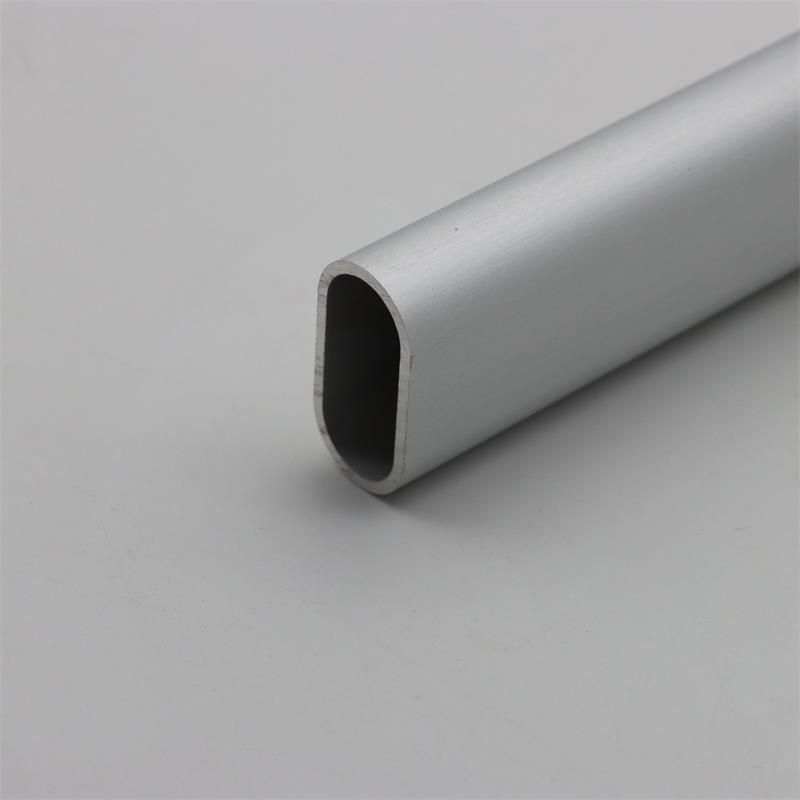
Vertical deflection resistance sits at the core of this shift. Gravity pulls straight down on your wardrobe rail. The oval profile features a taller vertical axis, typically measuring 30mm high. This tall orientation provides superior resistance to downward bending. A symmetrical round tube of the exact same material volume bends much sooner. The oval shape optimizes structural integrity exactly where the weight pulls strongest.
Anti-slip geometry offers another major advantage. The flat, vertical sides of an oval rail prevent hangers from swinging wildly. They cannot twist excessively. This smart geometry keeps your clothes uniformly aligned. It reduces frustrating friction noise when you browse your garments.
Finally, hardware compatibility greatly favors the oval design. Oval end flanges fit incredibly tight to the rail's specific contour. This precise fit eliminates the annoying rattle often associated with round rods. Round rods tend to roll freely inside loosely fitted, oversized end cups. The oval shape locks securely into its designated bracket, stopping unwanted rotation entirely.
Building a reliable organizational space requires careful planning and exact component matching. You must never purchase closet hardware piecemeal without verifying cross-compatibility. Specifying the right flanges, supports, and materials guarantees long-lasting performance.
Take the following action steps to finalize your system:
A: Yes. Both aluminum and steel tubes can be cut using a hacksaw or a non-ferrous metal cutting blade. Always deduct the thickness of the two end flanges (typically 2-4mm total) from your overall measurement before cutting.
A: If mounting into a wood shelf or cabinet panel, standard #6 or #8 pan-head wood screws (typically 5/8" or 3/4" length) are sufficient. For drywall, heavy-duty toggle bolts or drywall anchors are mandatory.
A: A 1.3mm thick steel tube, properly supported at both ends without exceeding a 48-inch span, can typically support 45 to 75 lbs per linear foot, safely accommodating heavy outerwear.


